Ultimate Photo Tips Welcome Tab


Ultimate Photo Tips

We’re here to help with photo tips to inspire you and help you learn!

Ultimate Photo Tips provides friendly education and encouragement for photo enthusiasts around the world, presented in a way that’s clear, organized, and easy to understand. We have hints and tips to hone your skills and boost your creativity, whether you’re looking for the answer to a specific question, or just want to explore and learn.

Two fabulous eBooks on Close-up Photography!

Ultimate Photo Tips Ultimate Photo Tips

Buy now!

Each one is a 60-page, downloadable PDF eBook full of helpful tips, useful information, and spectacular, full color images to inspire you to create better close up photographs.

Only USD$8 each, or USD$12 for the pair.


Color in Photography


Color in Photography


You can use color in your photographs to convey emotion and mood. Choose colors that are consistent with your message to tell a strong story. Watch below to find out more!

tweet it!


Spread the joy! Share today’s tweetable!

Video Transcript

Hello! It’s Julie from Ultimate Photo Tips. I want to do something fun for today’s two minute tip. I’m going to talk about color. Specifically, I’m going to talk about how color in photography can convey emotion and mood.

We humans are very sensitive to color. And we’re also really good at making associations; our brains are wired to do it. Ideas and concepts get linked together through our experiences and our learning. It’s not really surprising then, that we have associations with different colors. Think about it. Red is the color of love, or sometimes anger — definitely a passionate color. Blue is calm and tranquil, and makes us think of water. Green evokes images of Nature. White is pure, clean, innocent. We also divide colors into warm and cool.

When you are taking photographs, you can use these color associations to strengthen the story you are telling. Here’s an example. Imagine that you are shooting an advertisement for a resort in the Caribbean. The resort wants to draw snowbirds down from up north to enjoy the hot weather. You want to photograph a beach scene with golden sand, a woman wearing a yellow bikini, lying on an orange beach towel, under a red umbrella. You get the idea — use the warm color palette. Now the resort wants to get the message across that when it gets too hot, you can cool off at their swim-up bar. Then you want to photograph a woman beside a sparkling turquoise pool, wearing white, and blue, and sipping on a mint green cocktail. That cool color palette will really emphasize your message.

Imagine for a moment if you were to reverse the color palettes for each of those two shots. In that case, the colors would be working against your message, and you would be weakening your story.

[wearing warm colors] Look at the colors you are seeing right now in this video. I’m ready for the beach with my lobster pal, Thermidore! What feeling do these colors give you?

[wearing cool colors] Okay, see the difference? These colors tell an entirely different story. How do these colors make you feel?

So, the bottom line is: using color in photography that is consistent with the story you want to tell will strengthen your message.

That’s it for this week! If you enjoyed this video about color in photography, please spread the love, and share with with your friends! And I’ll see you next time.

Want to Make Photos that "WOW?"

If so, we can help you learn:

creativity exercises

  1. the A-Z of exposure and composition
  2. how to translate what you see into a photo that conveys how you feel
  3. how to be a more creative photographer

Just enter your name and email below and click “Sign me up!” to receive our friendly and helpful newsletter. Plus, get your welcome bonus, “12 Fun Exercises to Inspire Your Photographic Creativity.”


I am also interested in news about…


(it’s free!)


Picture CompositioneBook


Picture Composition


Picture Composition
eBook

They say a picture is worth a thousand words. But do your pictures say the right thousand words? Let me help you take pictures you can be proud of by showing you some techniques to be a more effective story-teller with your images. Too often, we struggle to translate the way we feel when we view a scene into a final image that evokes those same feelings. This downloadable PDF eBook can help! Start improving your picture composition today.

picture composition Some love from a reader:

“Hi. I am Salman. I am new to photography. I read your book “Story telling through visual design”. I want to congrat you on writing such a simple, precise yet well explanatory book. Your book has helped me a lot in gaining confidence in photography. Your efforts are well appreciated. If you ever find time, please have a look on my work where you might see a shadow of your book. Regards,”

Salman Ali, Islamabad, Pakistan, salmanimam70@yahoo.com

Create Photographs You Can Be Proud Of

Have you ever felt let down that your photograph didn’t capture the way you felt when you saw the scene? It’s challenging to translate a complete sensory experience in 3D onto a flat image on the page. If you know a little bit about how our brains process visual information, then you can take advantage of that knowledge to create powerful images that you and your viewer will respond to. In this eBook, I share easy-to-implement tips that are based on the science of your brain. These tips will help you design your images deliberately in a way that gets your message across. No more clicking the shutter with your fingers crossed, and hoping that you get lucky! I will share picture composition tips and tricks that will fix the problems you’ve been experiencing.

Do you want to take better photographs? I want to help you to start taking pictures that will give you a sense of pride and accomplishment; pictures that will "wow" your friends, and that you’d be happy to hang on your wall. Learn from the informative content in this eBook, and be inspired by the beautiful and creative images.

Picture Composition eBook

picture composition

picture composition


What’s Inside?

Story-Telling through Visual Design is a 62-page, downloadable PDF eBook densely packed with useful information, helpful tips, and spectacular, full color images to inspire you to create better photographs.

Rules
I’m not a fan of blindly following rules; it stifles creativity. Rules do exist for a reason; the way our brains works means that the way you respond to an image is predictable. Understanding this allows you to follow or break rules in order to best tell your story.

Visual Design Elements
Learning picture composition is like learning a foreign language. First you must learn the vocabulary. Visual design elements are the vocabulary of photographs. They are the building blocks of your image. In this eBook, I discuss light, including color and tone, as well as lines and shapes. Everything is explained in the context of how it best tells your story.

Visual Design Principles
After learning the vocabulary of a language, you then learn the grammar. This allows you to describe relationships. In photography, there is a set of visual design principles that will guide you to the most effective arrangement of your visual design elements so that you get your message across. In this eBook, I discuss dominance, balance, visual weight, and the use of positive and negative space.

And More!
To help you understand how the visual part of the brain works, I describe a few fascinating psychology experiments that provide evidence for the visual design principles that are presented. Take a peek at the inner workings of the mind!

ONLY $12! Buy now:

Add to Cart    
View Cart


What if I don’t have a PayPal account?

If you don’t have a PayPal account, don’t worry! The PayPal checkout interface gives you the option to pay by credit card, even if you don’t have a PayPal account.

How do I download my eBook?

After you’ve paid for the eBook, the PayPal checkout interface will display a "Click here to download…" link to download the your copy of the book.


Subject Placement:Go Beyond the Rule of Thirds


Subject Placement


Subject Placement:
Go Beyond the Rule of Thirds

Are you ready to go beyond the rule of thirds when placing your subject? Learn how the position of your subject relative to the frame relates to the story you want to tell with your photograph.

tweet it!


Spread the joy! Share today’s tweetable!

Video Transcript

Hello, it’s Julie here from Ultimate Photo Tips, and I’m back with another Two Minute Tip about subject placement. I’m not just going to give you the party line about the rule of thirds. Instead, I want to talk about how the placement of your subject relative to the edges of the frame relates to the story you want to tell. It all comes down to telling a story in the end, so we want all the choices we make when creating an image to support our story, and not distract from it.

Okay, so you’ve probably heard that it’s not a good idea to place your subject in the centre of the frame, because it makes the image too static. I say, "that depends." "Static" has some negative connotations. What if I replaced it with "stable?" Consider the following image:

subject placement

In this image, I’ve placed the subject dead centre. In this case, I think the image works. It works because my story is about that tree stump being solid and stable amidst the chaos of the rushing water. The subject placement echoes my theme.

Now let’s tackle that rule of thirds. It tells us to move our subject out of the centre, and into the thirds position, i.e., a third of the way in from the side, and a third of the way in from the top or bottom. That does make the image more dynamic, because it sets it off-balance. That can get the eye moving around more, which can be a good thing.

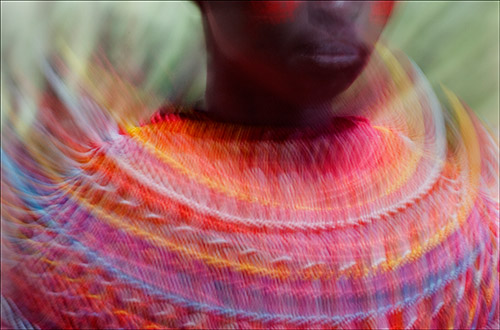
Now consider just how off-center you want to be. The thing is, the closer you place your subject to the edge of the frame, the more tension you create in the image. That’s because our brains are wired to give more attention to things at the edges. That holds double for placing your subject in a corner. Take a look at these next two photos.
subject placement

In this first photo (above), the three horses are in the bottom third of the image, and slightly to the left.

subject placement

In this next image (above), I’ve moved the horses much closer to the bottom left corner. This creates more tension, and I think it works in this image to emphasize the vast, empty space around the horses.

It’s always good to be in control of your subject placement, and make deliberate decisions that support your message. You do want to be careful not to inadvertently place a subject too close to the edge, or just touching the edge, because it will created an uncomfortable and undesirable tension. Take a look at this final pair of photos.

subject placement

In this first image of a sparrow, the tail feathers are touching the frame, and slightly cut off at the left. This just makes you wish that they were all in, and the brain spends all its time and attention on those pesky tail feathers, instead of looking around the rest of the image.

subject placement

Much better to get the whole bird in the frame, and give that tail a little space.

The moral of the story is to be deliberate with your subject placement, and choose a position that emphasizes stability, or tension, according to the story you want to tell.

That’s it for this week! If you’re looking for more tips, drop by ultimate-photo-tips.com, and sign up for my free newsletter while you’re there. Happy shooting, and I’ll see you next time.

Want to Make Photos that "WOW?"

If so, we can help you learn:

creativity exercises

  1. the A-Z of exposure and composition
  2. how to translate what you see into a photo that conveys how you feel
  3. how to be a more creative photographer

Just enter your name and email below and click “Sign me up!” to receive our friendly and helpful newsletter. Plus, get your welcome bonus, “12 Fun Exercises to Inspire Your Photographic Creativity.”


I am also interested in news about…


(it’s free!)


Aperture Priority Mode


Aperture Priority Mode


What is aperture priority mode? How do you use it? How does it work? Why would you want to choose this camera mode for shooting? Watch below to find out!

tweet it!


Spread the joy! Share today’s tweetable!

Video Transcript

Hi! It’s Julie here, from Ultimate Photo Tips. For today’s two minute tip, I want to talk about using "aperture priority mode" on your camera. It’s one of the semi-automatic modes that gives you some creative control, but also lets the camera do some of the heavy lifting for you. I’m going to talk about how to use the mode, how it works, and most importantly why you would want to use this mode.

First the how-to: If you are a Nikon user, then it’s very simple. On most Nikon DSLRs, just turn your mode dial to "A" — A for aperture It’s just as easy for Canon, only your setting is labelled "Av." For other than the big two brands, there will be something similar; just check the manual for your camera. Even some of the so-called point and shoot cameras will let you activate aperture priority mode. You might just have to dig through the menus a bit instead of getting access through one of the main dials.

Now, how it works: Once you’ve set the camera to use this mode, your main control dial will change – you guessed it! – the aperture. Now here’s the key part. You get to pick the aperture you want, and then your camera will choose a corresponding shutter speed to give you a correct exposure, based on the available lighting conditions. So you pick the aperture, and your camera picks a shutter speed.

Now the "why." Why shoot in this particular mode, as opposed to any other? I use aperture priority mode a lot — any time I’m photographing things that don’t move. If I’m photographing things that MOVE, then shutter speed is important to me because it determines how that motion will be rendered. But if I’m shooting something that doesn’t move, then my creative control comes from the depth of field. And depth of field is directly controlled by aperture. If I want a shallow depth of field, with not much in focus, then I choose a wide aperture. If I want lots of depth of field — lots in focus from front to back — then I choose a small aperture. So when my subject isn’t moving, then aperture priority mode fits the way I think through my shot. My priority is choosing the best depth of field to tell my story. I let the camera worry about getting the exposure right.

Now, you do need to pay attention to the shutter speed that the camera chooses for you; if it gets longer than about 1/60 second, you won’t be able to hand-hold without the camera shaking and creating blur. In that case, you need to consider putting your camera on a tripod to keep it steady.

That’s your two minute tip for today! If you like this video, please like it, tweet it and share it with your friends. For more great tips, be sure to visit ultimate-photo-tips.com and sign up for my newsletter, where I share tips, ideas and inspiration that I don’t share anywhere else!

Happy shooting, and see you next time.

Want to Make Photos that "WOW?"

If so, we can help you learn:

creativity exercises

  1. the A-Z of exposure and composition
  2. how to translate what you see into a photo that conveys how you feel
  3. how to be a more creative photographer

Just enter your name and email below and click “Sign me up!” to receive our friendly and helpful newsletter. Plus, get your welcome bonus, “12 Fun Exercises to Inspire Your Photographic Creativity.”


I am also interested in news about…


(it’s free!)


How to Hold a Camera


How to Hold a Camera


Learn how to hold your camera properly to maximize your stability and reduce blur due to camera shake. Watch below for a quick but useful tip.

tweet it!


Spread the joy! Share today’s tweetable!

Video Transcript for How to Hold a Camera

Hi! Back with you again today, I’m Julie from Ultimate Photo Tips. I have a really quick tip for you today, and we’re going right back to basics. This one’s all about how to hold a camera. Sounds simple enough, right? Well, I’ve seen many people coming into my workshops, and holding their camera like this [demonstrates]. Notice my left hand, and how it’s sitting on top of my lens? When your hand is on top of the lens like that, you can inadvertently put pressure on top, and push down on the lens, causing the camera to move. Instead, what you want to do is place your hand under the lens to support it. This is a much more stable way to hold the camera.

Also notice that I’m keeping my arms close in to my body. This adds stability too, rather than having my arms out here [demonstrates]. If you’re standing, it’s best to place your feet a little apart so that you are good and solid. You could also lean up against a post or a wall to make sure your position is secure, and keep that camera from moving.

That’s it – I told you it would be quick today! Remember to share this video if you enjoyed it, and come on over to ultimate-photo-tips.com to join my mailing list for more great tips and ideas. See you next time!

Want to Make Photos that "WOW?"

If so, we can help you learn:

creativity exercises

  1. the A-Z of exposure and composition
  2. how to translate what you see into a photo that conveys how you feel
  3. how to be a more creative photographer

Just enter your name and email below and click “Sign me up!” to receive our friendly and helpful newsletter. Plus, get your welcome bonus, “12 Fun Exercises to Inspire Your Photographic Creativity.”


I am also interested in news about…


(it’s free!)


Exposure Basics:What is Aperture?


Exposure Basics: What is Aperture?


Understanding exposure basics is crucial to making a great photograph. What is aperture? Invest some time to understand all the ingredients of exposure. Make sure you read the introduction to exposure first. Here we discuss aperture, and its effect on both exposure and depth of field.

Aperture Definition

The aperture is the opening in the lens that allows light through. Controlling how wide the opening is controls the amount of light that hits the sensor (or film). Just like with the other two ingredients of exposure, ISO and shutter speed, aperture is measured in increments of stops. In this case, we refer to them as f-stops.

Once again, a stop up or down will double or halve the amount of light hitting the film or sensor. Each aperture f-stop lets through half the light of the previous one. The standard f-stops are:

f/2.8, f/4, f/5.6, f/8. f/11, f16, f22

what is aperture
Illustration of the standard f-stops
Image source: http://wikipedia.org

To get the same exposure using an aperture of f/5.6 or f/8, we would have to compensate by varying one of the other ingredients of exposure: ISO or shutter speed. For example, if we open the aperture half as wide, we’d have to leave the shutter open twice as long to get an equivalent exposure.

How do you choose the right aperture?

Aperture affects more than just exposure. It also affects how much of the image is in focus. We call this depth of field.

Exposure Basics: What is Depth of Field (DOF)?

Depth of field refers to how much of the image is in focus. When you lock focus on a particular subject, there will be some amount of material both in front of and behind it that is also sharp and in focus. After that, focus will drop off, and things that are further away from your focal point will appear "soft" and out of focus.

Large apertures (e.g., f2.8) result in very little of the image on either side of the focal point being in focus. Small apertures (e.g., f/22) result in a lot of the image on either side of the focal point also being in focus.

1/3 of the range of in-focus material falls in front of the point on which you focus your camera, and 2/3 falls behind it. Assuming that the closest point in the image is at the bottom, and the furthest point is at the top, this means that to achieve the greatest amount in focus, you should focus at a point 1/3 of the way up the picture space.

aperture definition
The range in focus spans 1/3 in front of the focal point
and 2/3 behind.
(Image is not to scale)
© Julie Waterhouse Photography

Tip

Be careful when using a DOF in the mid range. It has it’s use, however sometimes, when only part of the image is in focus, it can look accidental, like you "missed" getting the focus right. This is especially true for close-up photography, where I always recommend committing to a point of view: soft focus, or detail, but not in-between.

A shallow depth of field means very little is in focus. This is called selective focus. Using this technique draws attention to the part of the picture that is in focus. It can also be used to minimize a distracting background; i.e., if the background is blurred through shallow depth of field, it draws less attention.

Use a small f-stop value, like f/2.8, which corresponds to a wide aperture opening, to achieve shallow depth of field. A small f-stop number means a small amount in focus.

A large depth of field, where you have a lot in focus, is useful if you want to show a lot of detail.

Use a large f-stop value, like f/22, which corresponds to a small aperture opening, to achieve large depth of field. A large f-stop number means a large amount in focus.


deep depth of field
Lots of detail, with a deep depth of field. Taken with an aperture of f/22.
© Julie Waterhouse Photography
shallow depth of field
Soft image, with shallow depth of field. Taken with an aperture of f/2.
© Julie Waterhouse Photography


Exposure Basics: Putting it all together

For an equivalent total exposure, a fast shutter speed requires a larger aperture (i.e., a smaller f-stop number), whereas a slow shutter speed requires a smaller aperture (larger f-stop number).

Exposure Basics: Exercise

Assume that each of the following should be an equivalent exposure. If you vary one of the three ingredients (ISO, shutter speed or aperture), you must vary another one to compensate. Test your understanding, and fill in the missing numbers.

ISO 200, f/8,   1/60s
ISO 400, f/8,   1/125s
ISO 200, f/11,  1/30s
ISO 400, f/5.6, 1/250s
ISO 100, f/8,   1/?s
ISO ?,   f/8,   1/125s
ISO 200, f/?,   1/125s

Don’t peek below until you try it yourself!

Answers: 1/30s, ISO 400, f/5.6

I hope that’s given you a good aperture definition to answer the question "What is aperture?"

Next, review ISO or shutter speed.

Next, you may be interested in learning about composition.


Photo Challenges: August 2012


Photo Challenges: August 2012


Photo Challenges:
August 2012

Rust

This month brings another topic from those collected from readers of the Ultimate Photo Tips Facebook Page. This month’s challenge topic is …drum roll, please … "Rust!" A favorite subject among many photographers, rust can be found on old cars, metal doors, garbage cans, in junk yards, and myriad other places. The great thing about rust, is that you can find it almost anywhere! Get creative. Photographing rust is about finding interesting textures, colors, and lines.

Read the rules. One entry only each month per person, please!

Enter your super-amazing photos in our photo contests. The winning image will be featured on the Ultimate Photo Tips homepage for all of the following month.

Submit your image.

See what other people are submitting, and vote for your favorite:
View other entries.


Feeling a Bit Rusty

photo contests
Rust Landscape
© Julie Waterhouse


photo contests
Nature Decorates in Matching Colors
© Julie Waterhouse


photo contests

The Colors of Rust
© Julie Waterhouse


photo contests

In the Old Car Graveyard
© Julie Waterhouse


photo contests

Wheel
© Julie Waterhouse


photo contests

Found in the Forest
© Julie Waterhouse


photo contests

Rusty Grille
© Julie Waterhouse


***C2_invitation_28701667***


Photo Inspiration


Photo Inspiration


Unplug from technology and find photo inspiration in Nature. Freelance photographer Katherine Keates brings us a motivating article that serves as a wake-up call to reconnect with our natural surroundings.

photo inspiration
© Katherine Keates

Insights and Inspiration
from nature

by Katherine Keates

photo inspiration
© Katherine Keates
Cactus Close-up Detail

In a day and age of high definition vision, media overload, and entertainment and communication in the palm of the hand, we have become increasingly hard to please, over-stimulated, yet at the same time, incredibly lazy. Mea culpa.

What we seem to have forgotten in this hubbub is how to quieten down, look deeper within and, for goodness sake, open our eyes. There are great works of art by Mother Nature herself that we brush by, step on and simply ignore in our quest for the bigger and better. While focused on SMS, iPods and iPads, the world is not only passing us by, but we are at increased risk of getting run over by it.

So I ask you: Is there any hope left for being struck by unsolicited, unplugged inspiration?

Perhaps so. At least I believe it.

"…believe it or not, creative photo inspiration is not something you can pick up on eBay from your Blackberry."

The best news of all is that to be truly, creatively inspired does not require expensive equipment and gadgets, or exotic tours and classes that promise take-home ‘winning’ images. And, believe it or not, creative photo inspiration is not something you can pick up on eBay from your Blackberry. In fact, you come equipped with the required equipment from day one, and it is FREE. The real secret lies in a killer combination of the mass of gray matter churning between our ears and two amazing orbs on either side of our nose that, when trained and practiced, can hone in on some of the most magical beauty known to humankind.

photo inspiration
© Katherine Keates
Wave-washed Sand, Thunder Beach, ON, Canada

We boast of how the world is getting smaller as we zoom in and out with Google Earth and how we find our way with GPS instead of orienteering with maps and compasses. Is this new small world really something to brag about? Isn’t it ironic, that when plugged in, our quest for photo inspiration dwindles exponentially? Can you still remember what happens when you pause, close in on your immediate surroundings, and allow yourself to feel the stirring within as Nature tells her incredible story? Perhaps this is the mysterious, exotic world we need to get to know or, in many cases, revisit.

photo inspiration
© Katherine Keates
Point Lobos Rocks at Low Tide, CA, USA

In the quietened mind’s eye, the bark of a tree or cactus can become a provocative piece of art hanging in our planet’s great gallery. The grains of sand on a beach offer texture and depth to a wave-formed sculpture that people simply walk over. Moving water washes colour over rocks like freshly dumped cans of paint. The vignetted leafy textiles of a garden or forest plant stimulate curiosity and wonder. All of this, and more, is out there, just waiting for us. So, be brave and take this challenge. Absorb all you can in this overly technical world because it is there for the taking, and it is useful; but then…STOP. Just go unplugged and unblogged for awhile. Capture a feeling instead of a trophy. Let the magic in, fill your pores, and let it move you to inner creative greatness.

photo inspiration
© Katherine Keates
White Sand Dune Close-up, South Africa


About Katherine Keates


Katherine Keates

A photographer for many years, Katherine’s love of photography has led her to explore many avenues in the art and craft of photography. She has explored and photographed in places such as South Africa, Namibia, Botswana, Kenya, Tanzania, France, Israel, Hawaii, Alaska, China, the Galapagos Islands, Ecuador and many North American national parks. She particularly loves to shoot on her home turf in Ontario, Canada.

She strives to present a unique vision and apply an artistic approach to all of her subjects. This national and international award-winning photographer has taught workshops and presented instructional programs. Her prints have been displayed in traditional and unique gallery situations, and in numerous exhibitions, and her work can be found on the walls of private homes and corporate offices.

She has participated on the speakers’ circuit for the Greater Toronto Council of Camera Clubs specializing in Audio Visual presentations and is a qualified international photographic judge. She is currently an active member and Vice President of the Toronto Focal Forum print makers group.

Katherine is also a freelance writer and has had numerous articles and images published in both local and international photographic publications such as BBC Wildlife Photographer of the Year, Photo Life, Pets Magazine, Best of Photography, Local Colour and the CAPA Journal.

Katherine welcomes you to visit her website at:

www.katherinekeatesphotography.com


photo inspiration
© Katherine Keates
Algonquin Park Autumn Reflection, ON, Canada


Next, you may want to read more articles from guest writers on learning digital photography.

Bulb Mode


Bulb Mode


What is the bulb setting on your camera all about? How do you use it? How does it work? Why would you want to choose this camera mode for shooting? Watch below to find out!

tweet it!


Spread the joy! Share today’s tweetable!

Video Transcript

Hello! It’s Julie here from Ultimate Photo Tips. Today’s two minute tip is all about bulb mode on your camera. This mode is typically used for taking exposures that are longer than 30", which is the longest shutter speed that’s programmed as a setting on your camera. You might use the bulb setting for doing night photography, where you need very long exposures to capture enough light. Or you might use it for photographing fireworks or lightning, where you leave the shutter open until the event occurs, and then end the exposure.

To use the bulb setting on your camera, switch to either manual mode or shutter priority mode, and then slow down your shutter speed until you get to 30 seconds. One more click should put you in bulb mode. Alternatively, on some Canon SLRs, there’s a bulb mode built right into the main control dial. Instead of Manual or shutter priority mode, you actually pick bulb directly. It’s marked with a "B."

bulb setting

In bulb mode, the shutter remains open for as long as shutter release is held down. That means that either your finger is holding down the shutter release button — which is not the best option, since you could be shaking the camera — or your cable release is locked into the shooting position. If you are using a wireless remote, you will press the remote once to open the shutter and a second time to close it.

That’s the bulb setting in a nutshell! If want more great tips, please visit me on ultimate-photo-tips.com, and be sure to sign up for my newsletter.

Happy shooting, and I’ll see you next time!

Want to Make Photos that "WOW?"

If so, we can help you learn:

creativity exercises

  1. the A-Z of exposure and composition
  2. how to translate what you see into a photo that conveys how you feel
  3. how to be a more creative photographer

Just enter your name and email below and click “Sign me up!” to receive our friendly and helpful newsletter. Plus, get your welcome bonus, “12 Fun Exercises to Inspire Your Photographic Creativity.”


I am also interested in news about…


(it’s free!)